
For home theatres
Soundproofing and acoustic treatment for home theatres in Doha
Two different jobs, in this order: stop the sound leaving the room, then tune what happens inside it. Panels alone do the second and almost none of the first. Manufactured in Palwal, India and supplied to Doha, Qatar with strong logistics.
- Isolation layer
- SoundBlanket® MLV, STC 34 at 4 mm
- Low frequency
- BassBloc®, NRC 0.85 at 20 mm, 100 to 500 Hz
- Finish layer
- PET felt, wood or foam, NRC 0.30 to 0.95
- Quote
- Within 48 hours, from a plan and a wall section
Send the room dimensions, the speaker layout and the existing wall and ceiling build-up. We manufacture and specify; we do not carry out on site installation or consultancy ourselves.
Quick answer for Doha: Stop sound leakage, control bass and echo, and improve dialogue clarity in a home theatre with the right panel placement on walls, ceilings and openings. MMT Acoustix manufactures these products in Palwal, India and supplies Doha, Qatar, with a quote within 48 hours.
01 / What actually goes wrong
Three separate problems, often treated as one
-
Sound gets out
Airborne sound passes through the wall, ceiling and door assemblies into the rest of the house. This is a mass and sealing problem, and no amount of absorption on the room face will fix it. A dense barrier layer inside the build-up is what changes it.
-
Bass travels through the structure
Below roughly 200 Hz the energy moves through the slab and the studwork rather than through the air, which is why a subwoofer is audible two rooms away while dialogue is not. Thin panels do nothing here. It needs a dense low frequency absorber in the cavity and corner treatment inside the room.
-
The room blurs what the speakers do
Hard parallel surfaces return energy to the seats a few milliseconds late, which smears dialogue and makes the response uneven from seat to seat. This one is absorption and diffusion, placed where the reflections actually are.
02 / The build-up
Three layers, in order, from the structure inwards
Each layer does one job the others cannot. Skipping the first and doubling the third is the most common and most expensive mistake in a home theatre.
-

Layer 1
SoundBlanket® mass loaded vinyl
The barrier. Fixed to the studwork or slab before the finish goes on, sealed at every joint and penetration, it is what stops sound leaving the room.
STC 30 at 2.5 mm, STC 34 at 4 mm, to ASTM E90. 2100 kg/m³. Class A surface burning to ASTM E84. Sheets 8 x 4, 16 x 4 and 32 x 4 ft.
-

Layer 2
BassBloc® low frequency absorber
The cavity layer. It absorbs where the subwoofer lives and damps vibration passing into the structure. It is installed behind the finish and is never left exposed.
NRC 0.85 at 20 mm, 0.95 at 40 mm, to ASTM C423. Effective 100 to 500 Hz. 100 kg/m³, 1800 x 900 mm rolls.
-

Layer 3
The acoustic finish
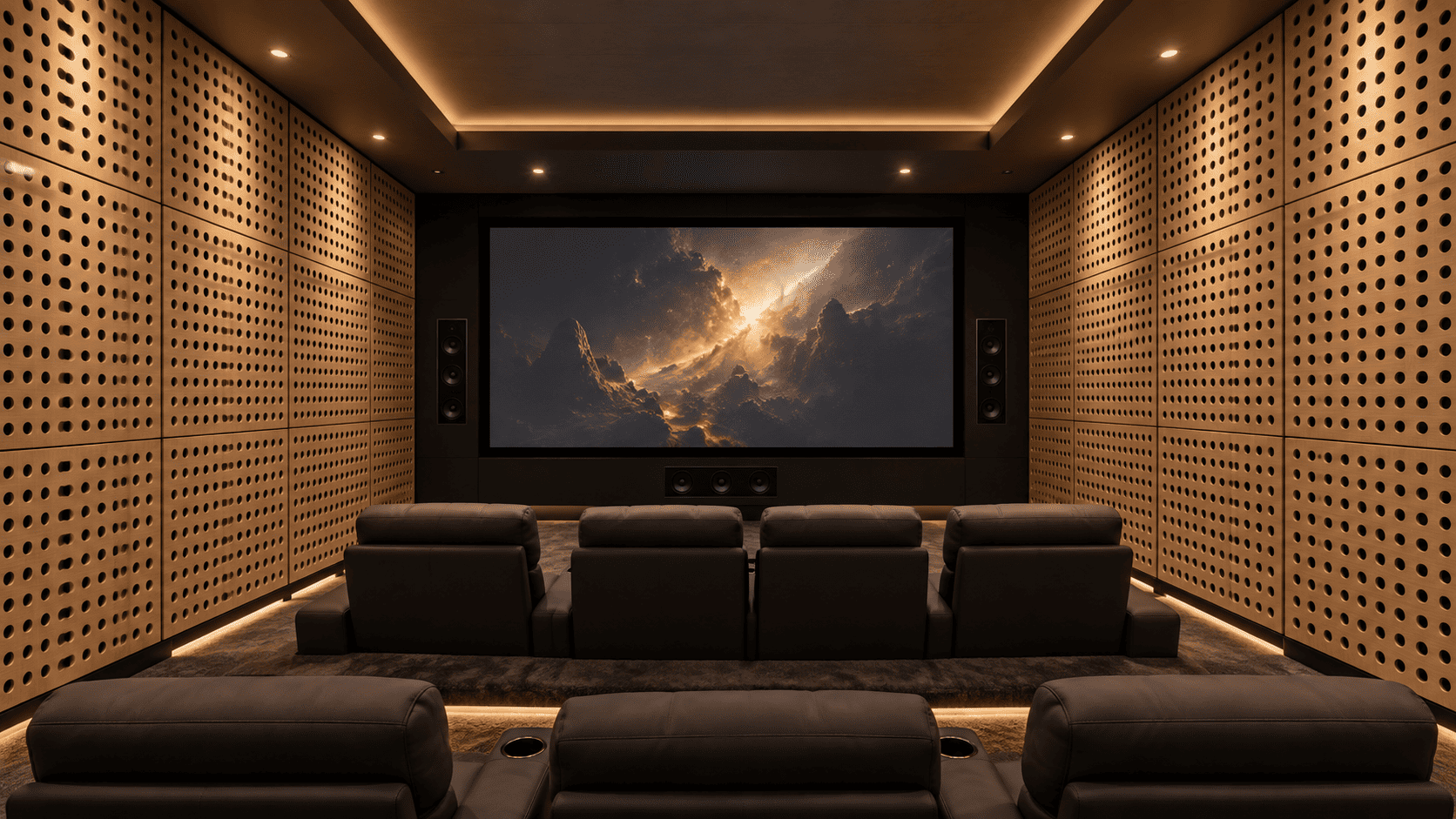
The visible face, and the layer that tunes the room. Absorption at the first reflection points, diffusion on the rear and side walls, and whatever the interior is meant to look like.
PET felt panels NRC 0.30 to 0.60, and 0.90 over 20 mm BassBloc® · Wooden slats NRC 0.75 · Fluted NRC 0.60 · Galaxy foam NRC 0.95 at 50 mm
Layer order by surface
| Surface | From the structure inwards | What it is for |
|---|---|---|
| Walls | SoundBlanket® 4 mm, then BassBloc® 20 mm in the cavity, then PET felt or wooden panels | Isolation, then low frequency, then clarity and finish |
| Ceiling | SoundBlanket® 4 mm above the false ceiling, then PET felt tiles or suspended baffles | Stops transfer to the floor above, then controls flutter echo |
| Floor | BassBloc® 20 mm under the finish, then acoustic carpet tiles | Vibration and impact into the slab |
| Door | Perimeter and bottom seals on a solid core door, soundproof curtain where a heavier leaf is not possible | The gap around a door undoes the wall it sits in |
| Corners | Bass traps floor to ceiling in the front corners | Where low frequency energy collects |
03 / Zone by zone
What goes on each surface, and why
-

Walls
Carry both jobs at once: the barrier and cavity absorber stop transfer, the visible panel controls reflections. Treat the first reflection points beside and behind the seating before adding coverage elsewhere.
- SoundBlanket® 4 mm, STC 34, inside the partition
- BassBloc® 20 mm, NRC 0.85, in the cavity
- PET felt panels or wooden slats as the face
-

Ceilings
The path to the room above, and the surface that causes flutter echo with a hard floor below it. The barrier sits above the false ceiling; absorption goes on the visible face.
- SoundBlanket® above the ceiling line
- Felt baffles, NRC 0.30 at 9 mm, where services stay exposed
- Felt ceiling tiles in a modular grid
-

Floors
Bass and footfall both move through the slab. A dense layer under the finish and a soft top surface deal with the two separately.
- BassBloc® 20 mm under the floor finish
- Acoustic carpet tiles, 4 mm, 500 x 500 mm
-

Doors and windows
The weakest element sets the result. A 6 mm gap around a door will undo a wall built to STC 50, so seal the perimeter and the threshold before spending anything on panels.
- Perimeter and bottom door seals, silicone and EPDM
- Soundproof curtain, STC 30, over openings
- Acoustic curtains, NRC up to 0.70, for reflections at glazing
-

Room tuning
Absorption at the reflection points, diffusion behind the seats, and traps in the corners. Coverage is a balance: strip the room of all reflection and it stops sounding like a cinema.
- Bass Trap Mega, NRC 1.0, 178 mm corner profile
- Acoustic foam, NRC 0.95 at 50 mm, for targeted reflections
- Wooden panels, NRC up to 0.75, for diffusion and finish
- Acoustic fabric for a seamless stretched face
04 / What we see go wrong
Five mistakes that cost the most to undo
-
Panels first, isolation never
The room sounds better inside and leaks exactly as much as before. Isolation is a build-up decision and has to happen while the walls are open.
-
No low frequency layer
Thin absorption on the wall face does almost nothing below 200 Hz, which is the frequency range a home theatre is actually judged on.
-
The door left as it is
A hollow leaf with a 6 mm undercut is the loudest part of most theatre walls, and the cheapest to fix.
-
Decorative foam bought as acoustic foam
Low density profile foam with no published NRC and no fire rating. It changes the photograph, not the measurement.
-
Panels spread evenly across every wall
Coverage in the wrong places leaves some seats bright and others dull. Placement is driven by the speaker layout and the seating distance.
05 / Specifications
Tested performance, with the standard it was measured to
| Product | Tested performance | Test standard |
|---|---|---|
| SoundBlanket mass loaded vinyl | STC 30 at 2.5 mm, STC 34 at 4 mm; 2100 kg/m³ | ASTM E90 |
| Echsorbix PET felt panels | NRC 0.30 at 9 mm, 0.40 at 12 mm, 0.50 at 18 mm, 0.60 at 24 mm | ASTM C423 / EN ISO 354 |
| BassBloc low-frequency absorber | NRC 0.85 at 20 mm, 0.95 at 40 mm; 100 kg/m³ | ASTM C423 |
| MMT Acoustix acoustic foam | NRC 0.90 at 50 mm (Pyramid); 0.95 at 50 mm (Galaxy) | ASTM C423 |
| SoundaXe wooden acoustic panels | NRC 0.75 (slats); 0.70 (perforated); 0.60 (fluted, 18 mm) | ASTM C423 |
| Soundproof curtains | STC 30, NRC 0.20, 4500 GSM; up to 30 dB reduction | ASTM E90 / C423 |
| Acoustic carpet | Indicative NRC 0.25 (in-house figure) | In-house measurement |
Test reports are issued with project supply. NRC and STC are the figures we publish and stand behind; anything beyond those two is the scope of an acoustic consultant. The full set of reports is listed on the certifications page.
06 / How we can help
What we do, and what we do not
-
We do
- Manufacture every layer above at the Palwal plant, Haryana
- Turn a room plan and a wall section into a specified build-up and a priced BOQ, usually within 48 hours
- Supply test reports, technical data sheets and specification text for the build
- Make panels to size, in custom colours and prints, with CNC cutting
-
We do not
- Carry out on site acoustic consultancy or measurement
- Install. We manufacture and supply the system
-
We refer
We work with associated acoustic consultants and installers across India and can put you in touch with them for design verification or execution. Ask when you send the drawing.
Questions