
MMT Acoustix® Anechoic Wedges
Anechoic Foam Wedges
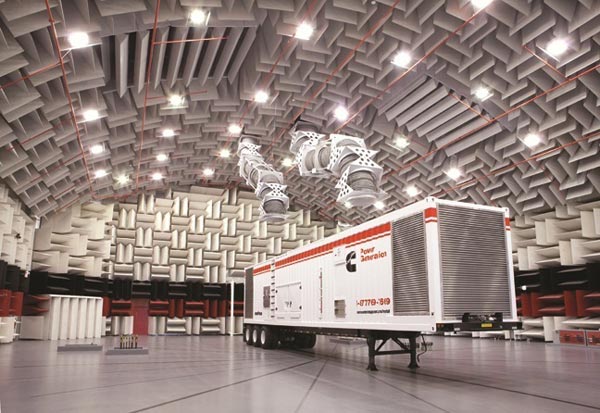
Acoustic wedges that absorb sound across a broad frequency spectrum to create an environment free from echoes and reverberation. Made to chamber specification by MMTPL at the Palwal plant, Haryana.
The problem it solves
What Anechoic Wedges fix for you
Reflections in test chambers
Wedges absorb sound so the chamber stays free of echoes and reverberation.
Unreliable acoustic measurements
A controlled acoustic environment for testing laboratories.
Echo across a wide band
Absorbs across a broad frequency spectrum, not just the top end.
Room colour in studios
Recording, broadcast and home studios get a dead, neutral space.
Noisy research spaces
Research facilities get a clean field for sound wave and frequency analysis.
Applications
Where Anechoic Wedges go
Anechoic chambers
Anechoic chambers
Full-room wedge lining to chamber specification.
Testing laboratories
Testing laboratories
Controlled acoustic environments for testing.
Research facilities
Research facilities
Sound wave and frequency analysis.
Recording studios
Recording studios
Maximum absorption for critical rooms.
Broadcast studios
Broadcast studios
Echo-free on-air spaces.
Home studios
Home studios
High absorption in a compact room.
How it works
From sound wave to silence
1. Entry
Sound waves enter the open foam structure.
2. Dissipation
Sound energy is dissipated within the material.
3. Absorption
Echo is eliminated through absorption.
4. Control
The result is a controlled acoustic environment.
Specifications
Technical data
| Material | High-density open-cell polyurethane acoustic foam |
| Manufacturer | MMTPL, Palwal plant, Haryana, India |
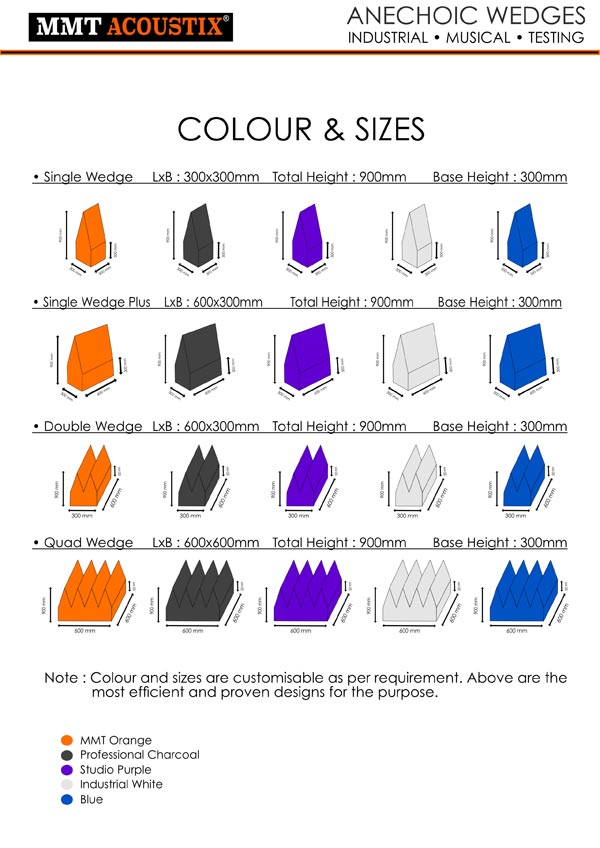
| Panel size | Custom, to chamber specification |
| Thickness | Wedge depth calculated from the target cut-off frequency |
| Density | 32 to 50 kg/m³ |
| NRC | 1.0 |
| Acoustic test standard | ASTM C423 |
| Absorption range | Mid to high frequency; wedge depth sets the low-frequency cut-off |
| Fire rating | Standard grade non-FR; UL 94 Class HS1 fire retardant grade on request |
| Size tolerance | ±5% |
| Colours | Charcoal Black, European Blue, MMT Orange, Stone White, Wine, Fire Red |
| Installation | Direct adhesive or mounting system |
| Maintenance | Vacuum on a low setting to remove dust. Do not wet-clean or compress wedge tips. |
| Country of origin | India |
Soundproofing: the fix for every sound problem
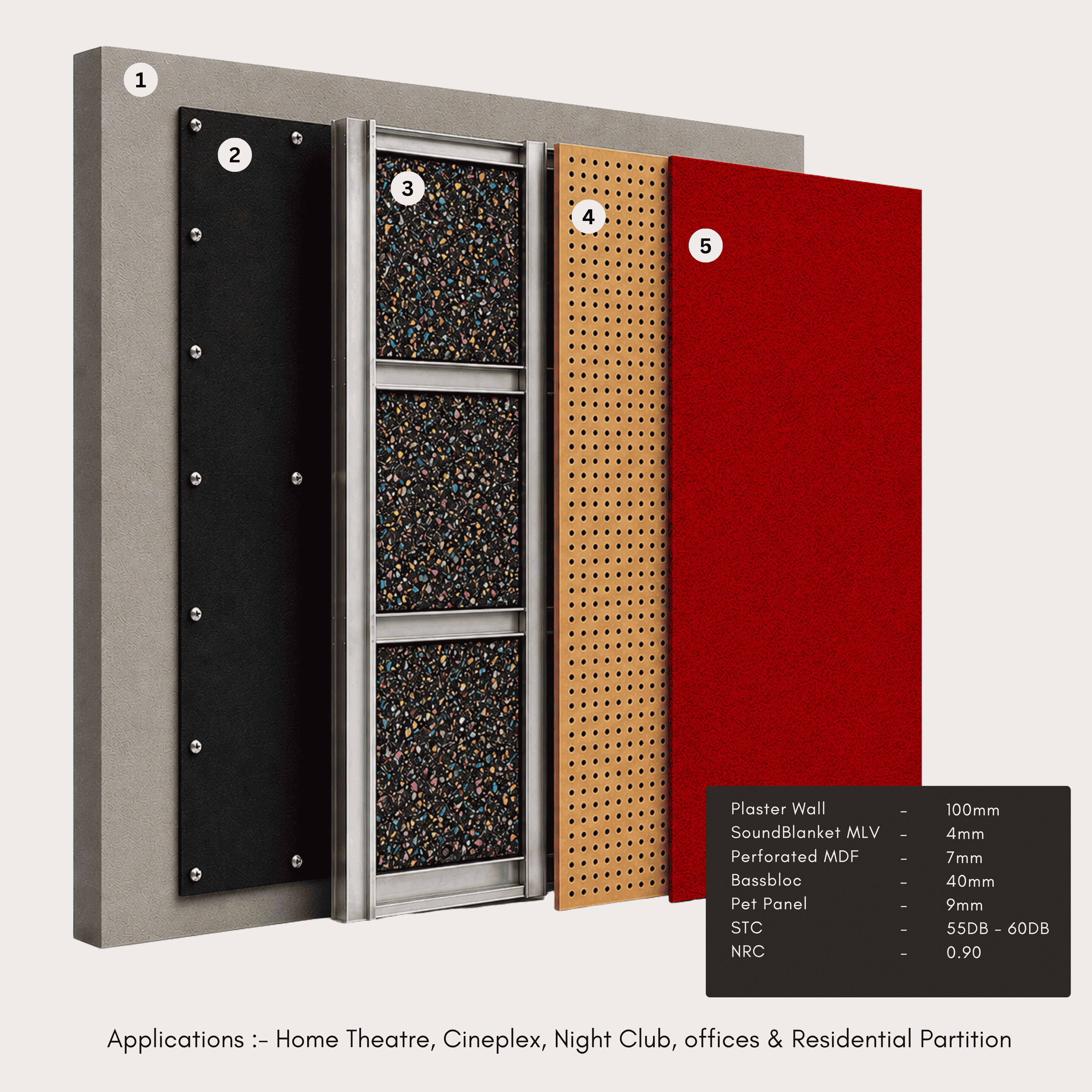
3-layer soundproofing
- 1
Layer 1: SoundBlanket® MLV
The dense barrier that isolates sound and stops it passing through walls, ceilings and floors.
- 2
Layer 2: BassBloc®
High-density sound absorber over the MLV that controls low-frequency noise.
- 3
Layer 3: Echsorbix®, SoundaXe® or WDWL®
The final acoustic finish: Echsorbix® PET felt, SoundaXe® wooden acoustics or WDWL® wood wool panels.
Layer 2 can also be covered with gypsum or cement board before adding the final acoustic layer.
Different thickness in each layer will give different STC and NRC levels.
Custom and OEM
Built to your chamber
Multiple sizes, shapes and configurations, made to chamber specification. Tell us the space, the area you are covering and the finish you want, and our team will confirm specification, pricing and lead time.
FAQs